
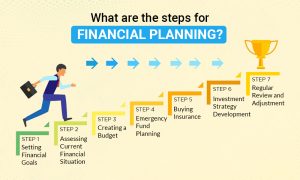
Financial planning is the process of organising your money around your goals. It helps you decide what to do with income, savings, debt, insurance, investments and pensions. A good plan gives each financial decision a purpose instead of reacting month to month.
What is financial planning?
Financial planning means looking at your current position, deciding what you want to achieve and creating steps to move from one to the other. It can be simple or detailed depending on your circumstances.
For some people, the first plan is to stop overspending and build emergency savings. For others, it may involve retirement planning, investment strategy, tax efficiency, property goals or business succession.
Step 1: Understand your current position
Start by listing income, spending, debts, savings, pensions, investments and insurance. Calculate your net worth by subtracting debts from assets. This gives a snapshot of where you are today.
Do not worry if the starting point is not ideal. Financial planning is about progress, not perfection.
Step 2: Set clear goals
Good financial goals are specific and measurable. “Save more” is vague. “Save £3,000 for an emergency fund within 12 months” is clearer. Goals can be short term, medium term or long term.
- Short term: Emergency fund, holiday, clearing overdraft.
- Medium term: House deposit, car replacement, education costs.
- Long term: Retirement, mortgage freedom, financial independence.
Step 3: Build a budget
A budget is the engine of a financial plan. It shows whether your goals are affordable and what trade-offs are needed. Without a budget, financial planning becomes guesswork.
Review spending categories and identify money that can be redirected toward savings, debt repayment or investments.
Step 4: Manage debt
Debt strategy depends on interest rates, affordability and risk. Expensive debts such as credit cards, overdrafts and high-interest loans often need priority. Low-rate long-term debt may be managed alongside saving and investing.
If debt repayments are unaffordable, seek debt advice early. Borrowing more is not always a solution.
Step 5: Create protection
Protection planning includes emergency savings and insurance. Consider what would happen if income stopped, a partner died, illness prevented work or a major repair was needed.
Insurance needs vary by household. A single renter with no dependants may need different cover from a homeowner with children.
Step 6: Save and invest
Savings are usually suitable for short-term goals and emergencies. Investments may be suitable for longer-term goals where you can accept risk and volatility. Pensions and ISAs may offer tax advantages, depending on eligibility and rules.
Do not invest money needed in the near future. Timeframe is one of the most important parts of investment planning.
Step 7: Review regularly
A financial plan should change as life changes. Review it after major events such as marriage, children, moving home, job changes, inheritance, business changes or approaching retirement.
Common financial planning mistakes
- Setting vague goals.
- Ignoring emergency savings.
- Focusing on investments while carrying expensive debt.
- Not protecting income or dependants.
- Forgetting pensions.
- Never reviewing the plan.
Frequently asked questions
Do I need a financial adviser?
Not always. Simple budgeting and saving can be managed independently, but advice can help with pensions, investments, tax planning or complex decisions.
How often should I review my plan?
At least once a year and whenever your circumstances change significantly.
Should I save or invest first?
Many people build emergency savings first, then invest for longer-term goals once short-term security is in place.
What is the first step?
List your income, spending, debts and savings. Clarity is the starting point.
Final thoughts
Financial planning is not only for wealthy people. It is for anyone who wants their money to support a better, more secure life. Start with clear goals, build simple systems and review progress regularly.
Disclaimer: This article is for general information only and does not constitute financial, investment, tax or pension advice. Consider regulated advice for complex decisions.