
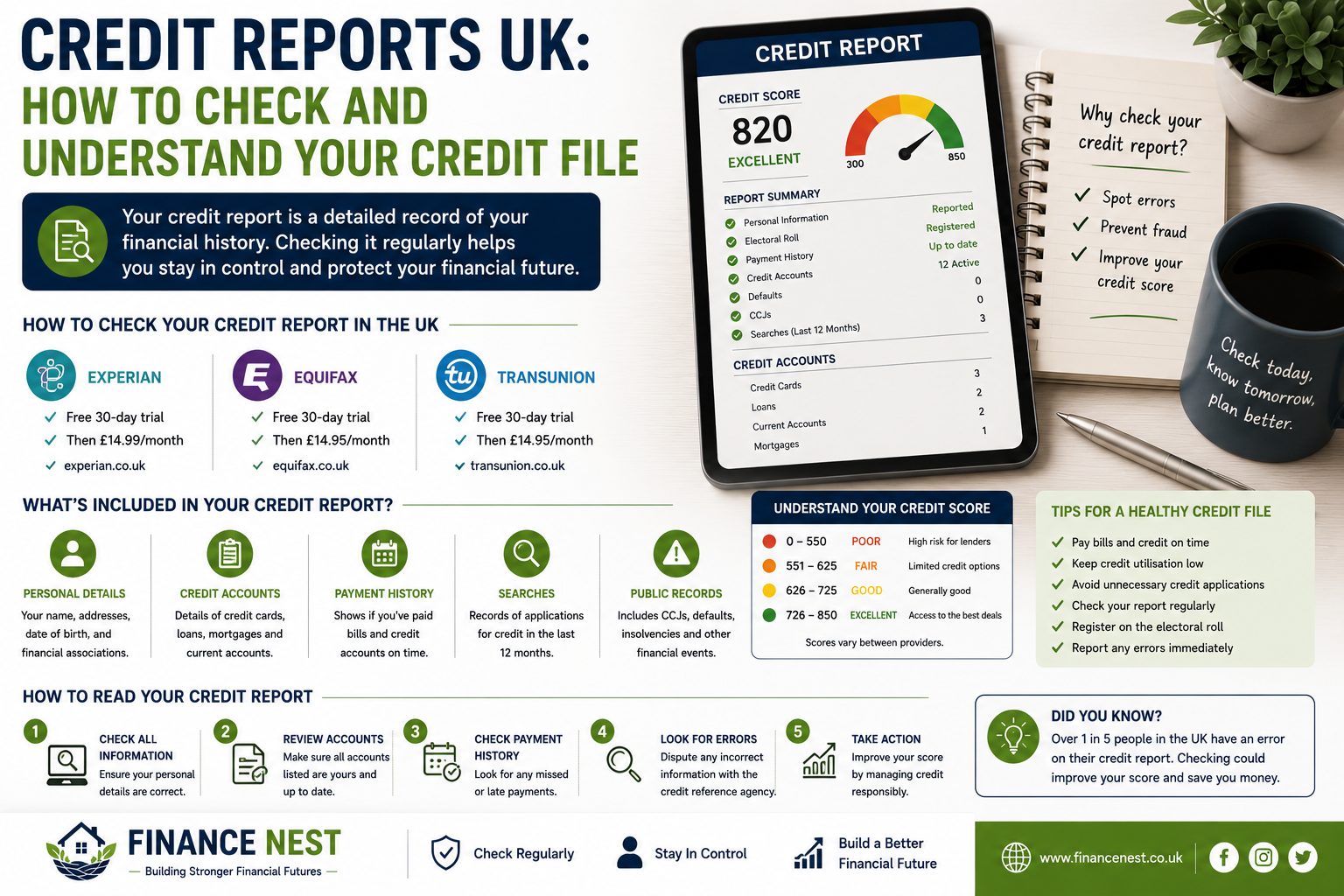
Many people know their credit score, but far fewer understand their credit report.
While a credit score is simply a number, your credit report contains the actual information lenders use when assessing applications for mortgages, loans, credit cards, car finance, mobile contracts, and even some rental agreements.
Understanding your credit report can help you:
- Spot errors before they become a problem
- Identify potential fraud
- Improve your chances of borrowing
- Prepare for major applications such as mortgages
- Monitor your financial health
In the UK, millions of consumers only review their credit reports when they are rejected for credit. By that point, correcting issues can take time and may delay important financial plans.
This guide explains what credit reports are, what information they contain, how lenders use them, and how you can keep your credit file accurate and healthy.
What Is a Credit Report?
A credit report is a record of your borrowing and repayment history.
It contains information collected by credit reference agencies and supplied by lenders, banks, utility companies, mobile phone providers, and other organisations.
Your credit report helps lenders assess:
- Financial responsibility
- Repayment history
- Existing borrowing
- Risk level
- Identity verification
Think of it as your financial track record.
Just as employers review CVs before hiring staff, lenders often review credit reports before offering finance.
The Three Main UK Credit Reference Agencies
The UK has three major credit reference agencies:
Experian
One of the largest credit reference agencies in the UK.
Equifax
Widely used by banks, lenders and financial institutions.
TransUnion
Another major provider used by many lenders.
A common mistake is assuming all three reports are identical.
They are not.
Different lenders report information to different agencies, meaning your files may contain slightly different information.
This is why it is often advisable to check all three.
What Information Appears on a Credit Report?
Credit reports contain several types of information.
Personal Details
These usually include:
- Full name
- Date of birth
- Current address
- Previous addresses
Lenders use these details to verify identity.
Incorrect address information can sometimes create problems during applications.
Electoral Roll Information
Electoral roll registration helps confirm:
- Identity
- Residency
- Address history
Many lenders view electoral roll registration positively because it increases confidence that applicants are genuine.
Credit Accounts
Most reports include:
- Credit cards
- Personal loans
- Mortgages
- Store cards
- Finance agreements
For each account, information may include:
- Account opening date
- Credit limit
- Outstanding balance
- Repayment history
- Account status
Payment History
This section is often particularly important.
It shows whether payments were:
- Made on time
- Late
- Missed
Consistent on-time payments generally create a stronger profile.
Repeated missed payments may concern lenders.
Credit Searches
Whenever you apply for credit, a search may be recorded.
There are two main types.
Soft Searches
Usually visible only to you.
Examples include:
- Eligibility checks
- Identity verification
Soft searches generally do not affect lending decisions.
Hard Searches
Visible to lenders.
Examples include:
- Loan applications
- Credit card applications
- Mortgage applications
Multiple hard searches within a short period may indicate increased borrowing activity.
Defaults
A default may appear when a lender believes a credit agreement has broken down due to missed payments.
Defaults are generally viewed more seriously than isolated late payments.
County Court Judgments (CCJs)
CCJs may appear when a creditor obtains a court judgment for unpaid debt.
Many lenders pay close attention to CCJs because they indicate previous legal action relating to debt.
Financial Associations
If you hold joint financial products with another person, an association may appear.
Examples include:
- Joint bank accounts
- Joint mortgages
- Joint loans
This does not mean you are responsible for all their borrowing.
However, lenders may consider linked financial relationships.
Credit Report vs Credit Score
Many consumers confuse the two.
Credit Report
Contains detailed information about your financial history.
Credit Score
A numerical summary created by a credit reference agency.
Your report is usually more important than your score.
A lender may ignore a high score if the underlying report contains concerns.
Similarly, a lower score may not prevent approval if the lender’s own assessment is positive.
Why Credit Reports Matter
Credit reports influence many financial decisions.
Mortgage Applications
Mortgage lenders often review credit history carefully because of the size of the borrowing involved.
Personal Loans
Credit reports help lenders assess repayment risk.
Credit Cards
Providers use reports to determine eligibility and pricing.
Car Finance
Vehicle finance companies frequently conduct credit checks.
Mobile Phone Contracts
Many providers perform credit assessments before approving contracts.
Rental Applications
Some landlords and letting agents use credit reports during tenant screening.
How to Check Your Credit Report
Checking your report should become a regular financial habit.
You can access information through:
- Experian
- Equifax
- TransUnion
- Credit monitoring services
- Banking apps offering credit report access
Before applying for major credit, reviewing all three reports is often worthwhile.
Common Errors Found on Credit Reports
Mistakes occur more often than many people realise.
Common examples include:
Incorrect Addresses
Old or incorrect address information may create confusion.
Duplicate Accounts
Occasionally accounts appear more than once.
Incorrect Payment Records
Payments may sometimes be reported inaccurately.
Closed Accounts Still Showing Active
Account status errors can occur.
Fraudulent Accounts
Identity theft may result in accounts you do not recognise.
What To Do If You Find an Error
If you discover incorrect information:
Step 1
Gather evidence.
Examples include:
- Statements
- Letters
- Account confirmations
Step 2
Contact the organisation that reported the information.
Step 3
Contact the relevant credit reference agency.
Step 4
Monitor progress until corrections are made.
Most agencies have formal dispute procedures.
Protecting Yourself Against Fraud
Credit reports can help identify fraud early.
Warning signs include:
- Unknown accounts
- Unexpected searches
- Unrecognised addresses
- New borrowing you did not request
If you notice suspicious activity:
- Contact lenders immediately
- Report potential fraud
- Monitor accounts closely
Early action can reduce financial damage.
Preparing for a Mortgage Using Your Credit Report
Mortgage applications often involve greater scrutiny.
Before applying:
Review All Credit Files
Check all major agencies.
Correct Errors
Resolve inaccuracies early.
Reduce Outstanding Debt
Lower balances can strengthen affordability assessments.
Avoid New Credit Applications
Multiple applications may raise concerns.
Keep Payments Up to Date
Recent payment history matters.
Many mortgage advisers recommend preparation several months before applying.
How Often Should You Check Your Credit Report?
A sensible approach is:
Every Month
If actively rebuilding credit.
Every Quarter
For regular monitoring.
Before Major Applications
Mortgages, loans and finance agreements.
After Identity Theft Concerns
Check immediately.
Regular reviews help identify issues before they become serious.
Myths About Credit Reports
Myth: Checking My Report Hurts My Credit Score
False.
Reviewing your own report usually involves a soft search.
Myth: All Credit Reports Are Identical
False.
Different agencies may hold different information.
Myth: Errors Fix Themselves
Usually not.
Most errors require action.
Myth: Credit Scores Matter More Than Reports
Not always.
Many lenders focus heavily on report contents.
Frequently Asked Questions
How many credit reports do I have?
Most consumers have records with Experian, Equifax and TransUnion.
Can lenders see all my reports?
Not necessarily.
Different lenders may use different agencies.
How long does information remain on my report?
This depends on the type of information involved and reporting rules.
Should I check all three agencies?
Yes, particularly before important applications.
Can incorrect information be removed?
If information is inaccurate, you can request corrections through formal dispute processes.
Final Thoughts
Your credit report is one of the most important financial documents you have.
While many people focus exclusively on their credit score, lenders often pay far greater attention to the information contained within the report itself.
Regularly reviewing your credit file, correcting errors, monitoring for fraud and maintaining responsible borrowing habits can strengthen your financial profile and improve future borrowing opportunities.
Whether you’re preparing for a mortgage, improving your credit score or simply taking control of your finances, understanding your credit report is an essential step towards better financial health.
Disclaimer: This article is for educational purposes only and does not constitute financial, legal or credit advice. Always consider your individual circumstances and seek professional advice where appropriate.