
Buying a property is one of the largest financial commitments most people will ever make. Whether you’re purchasing your first home, moving to a larger property, or investing in real estate, it is essential to understand exactly what you are buying.
Many buyers focus heavily on securing a mortgage and negotiating a purchase price but overlook one critical step: the property survey.
A survey can reveal hidden defects, structural issues, damp problems, roof damage, subsidence, electrical concerns, and other costly issues that may not be obvious during a viewing.
In some cases, a survey can save buyers thousands of pounds by uncovering problems before contracts are exchanged.
This guide explains the different types of property surveys available in the UK, how they work, what they cost, and how to decide which survey is most appropriate for your property purchase.
What Is a Property Survey?
A property survey is a professional inspection carried out by a qualified surveyor to assess the condition of a property.
The purpose is to identify:
- Structural issues
- Maintenance concerns
- Defects
- Potential future problems
- Repair requirements
A survey provides buyers with valuable information before completing the purchase.
Think of it as a health check for a property.
Why Property Surveys Matter
Many buyers ask:
“Do I really need a survey?”
The answer is almost always yes.
Properties can appear perfectly fine during viewings while hiding significant problems.
Common issues discovered by surveys include:
- Damp
- Roof defects
- Timber decay
- Subsidence
- Drainage issues
- Structural movement
- Insulation problems
- Electrical concerns
Without a survey, buyers may inherit expensive repairs after completion.
Mortgage Valuation vs Property Survey
One of the biggest misconceptions is believing that a mortgage valuation is a survey.
They are not the same thing.
Mortgage Valuation
A mortgage valuation is carried out on behalf of the lender.
Its purpose is to confirm that the property provides adequate security for the mortgage loan.
The valuation primarily protects the lender.
It does not provide a detailed assessment of the property’s condition.
Property Survey
A property survey is commissioned by the buyer.
Its purpose is to identify defects and maintenance concerns.
It protects the buyer.
Many people wrongly assume a mortgage valuation is sufficient and later discover unexpected problems.
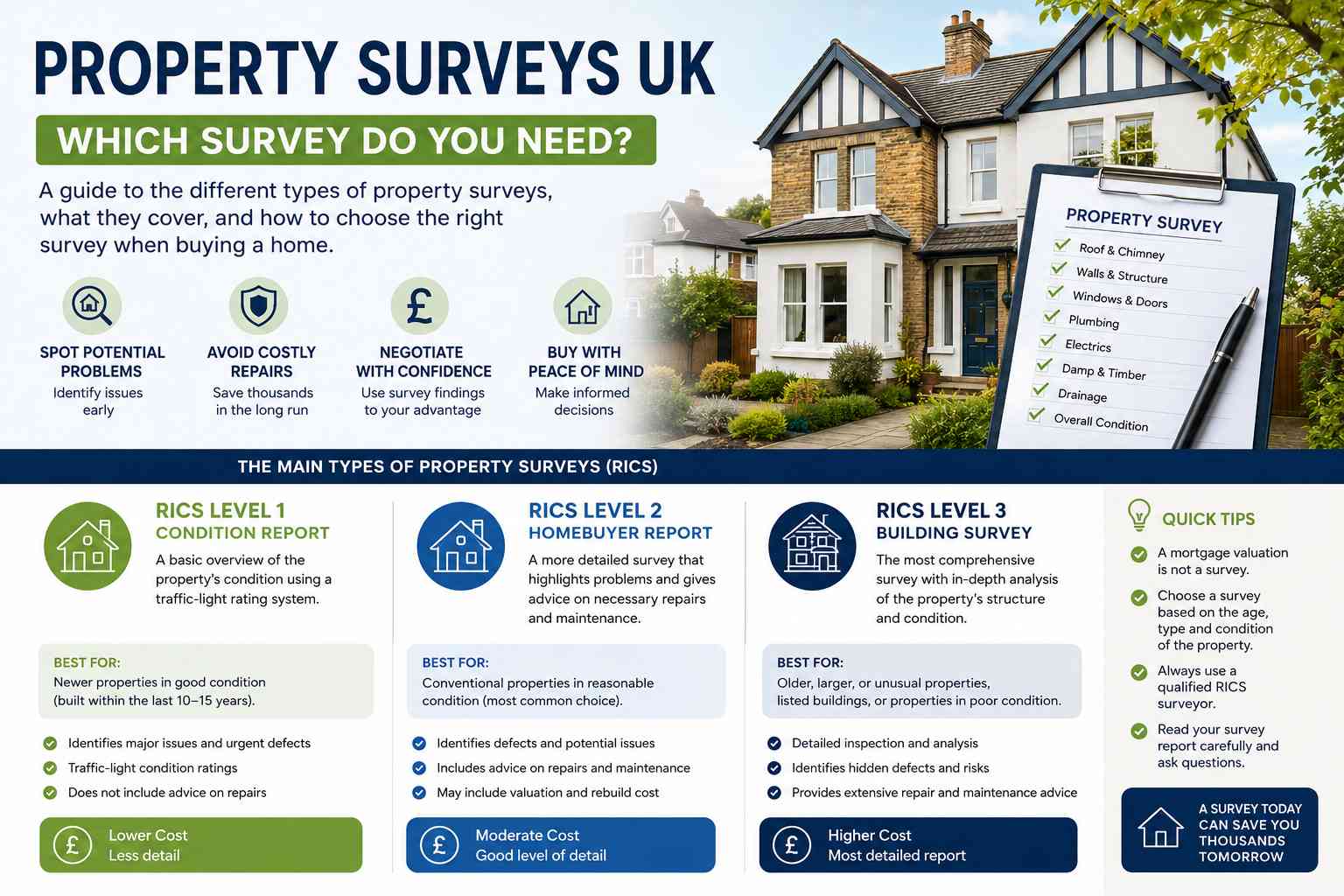
The Main Types of Property Surveys
The Royal Institution of Chartered Surveyors (RICS) provides several levels of surveys.
RICS Level 1 Survey
Previously known as:
Condition Report
This is the most basic survey available.
What It Covers
The surveyor provides:
- General condition overview
- Traffic-light rating system
- Major visible defects
- Urgent issues requiring attention
Suitable For
Generally appropriate for:
- Modern properties
- New-build homes
- Properties in good condition
Limitations
It does not provide:
- Detailed repair advice
- Valuation
- Extensive investigation
For many buyers, a more comprehensive survey offers greater protection.
RICS Level 2 Survey
Previously known as:
HomeBuyer Report
This is one of the most popular survey options.
What It Covers
The survey includes:
- Property condition assessment
- Significant defects
- Maintenance recommendations
- Potential future issues
- Building services overview
Many Level 2 surveys also include:
- Property valuation
- Insurance rebuild cost estimate
Suitable For
Ideal for:
- Conventional properties
- Homes built within the last century
- Properties appearing reasonably maintained
Advantages
Provides a good balance between:
- Cost
- Detail
- Practical guidance
For many buyers, Level 2 surveys represent excellent value.
RICS Level 3 Survey
Previously known as:
Building Survey
This is the most detailed survey available.
What It Covers
The surveyor conducts an extensive inspection and provides:
- Detailed structural analysis
- Defect investigation
- Repair recommendations
- Maintenance planning
- Building construction assessment
Suitable For
Recommended for:
- Older properties
- Listed buildings
- Unusual construction types
- Renovation projects
- Properties with visible defects
Advantages
Offers the highest level of detail.
Particularly useful where substantial repairs may be required.
How Much Does a Property Survey Cost?
Survey costs vary depending on:
- Property value
- Property size
- Property location
- Survey type
Typical costs may range from a few hundred pounds for basic surveys to significantly more for detailed building surveys.
While surveys involve an upfront expense, they may prevent much larger repair costs later.
Common Problems Found During Surveys
Surveyors frequently identify issues that buyers may not notice themselves.
Damp Problems
Damp is one of the most common defects found in UK properties.
Possible causes include:
- Poor ventilation
- Roof leaks
- Rising damp
- Plumbing issues
Roof Defects
Repairs can be expensive.
Common issues include:
- Missing tiles
- Damaged flashing
- Structural deterioration
Subsidence
Subsidence occurs when the ground beneath a property moves.
Potential warning signs include:
- Cracks in walls
- Uneven floors
- Doors sticking
Professional assessment is essential.
Timber Decay
Surveyors may identify:
- Wet rot
- Dry rot
- Woodworm
Early detection can reduce repair costs.
Electrical Concerns
Older wiring systems may require upgrades.
A surveyor may recommend specialist inspections where necessary.
Can a Survey Help Negotiate the Purchase Price?
Yes.
One major benefit of a survey is that it provides evidence.
If significant defects are discovered, buyers may:
- Renegotiate the purchase price
- Request repairs
- Reconsider the purchase entirely
For example:
If a survey identifies £10,000 of roof repairs, the buyer may negotiate a price reduction.
This can make the survey highly cost-effective.
Should First-Time Buyers Get a Survey?
Absolutely.
First-time buyers often have limited experience identifying property defects.
A survey provides:
- Professional guidance
- Greater confidence
- Protection from unexpected costs
Buying a property without a survey can be a significant risk.
New-Build Properties and Surveys
Some buyers assume new-build homes do not require surveys.
This is not always true.
New-build properties can still experience:
- Construction defects
- Snagging issues
- Finishing problems
Specialist snagging surveys are often recommended for newly built homes.
When Should You Arrange a Survey?
Typically:
- Offer accepted
- Survey instructed
- Mortgage application progresses
- Survey report received
Arranging surveys early helps identify problems before significant legal costs are incurred.
Understanding Survey Results
Many survey reports use a traffic-light system.
Green
No significant concerns.
Amber
Issues requiring monitoring or maintenance.
Red
Serious concerns requiring immediate attention.
Red-rated items often warrant further investigation.
Questions to Ask After Receiving a Survey
Consider:
- What repairs are urgent?
- What repairs can wait?
- What are the likely costs?
- Should specialist inspections be arranged?
- Does the property remain good value?
A survey should inform decision-making rather than automatically discourage a purchase.
Common Survey Myths
Myth: New Homes Don’t Need Surveys
False.
Construction defects can occur in new properties.
Myth: Mortgage Valuations Are Surveys
False.
Valuations primarily protect lenders.
Myth: Surveys Are Too Expensive
Compared with major repair costs, surveys often provide excellent value.
Myth: Older Properties Always Have Problems
Not necessarily.
Many older properties are exceptionally well maintained.
Frequently Asked Questions
Is a survey legally required?
No, but it is highly recommended.
Which survey should I choose?
It depends on the age, condition, and type of property.
Can a survey stop me buying a property?
It provides information to help you make an informed decision.
How long does a survey take?
This varies depending on the property and survey type.
What happens if serious defects are found?
You may renegotiate, request repairs, seek specialist advice, or reconsider the purchase.
Final Thoughts
A property survey is one of the most important investments you can make when buying a home.
While it adds an upfront cost to the buying process, it can provide valuable insight into the property’s condition and potentially save thousands of pounds in unexpected repairs.
Whether you choose a basic survey or a detailed building survey, the information gained can help you make informed decisions, negotiate effectively, and purchase with greater confidence.
When buying a property, knowledge is one of the most valuable assets you can have.
Disclaimer: This article is for general information only and does not constitute legal, financial, or surveying advice. Always seek professional guidance appropriate to your circumstances.